For a café, tea bar or beverage manufacturer, choosing a latte matcha is a sourcing decision, not a recipe tweak. This B2B guide from RongQing Tea covers the biochemistry, grade logic, milk chemistry, dosing and preparation that decide whether a matcha reads cleanly through milk at scale — or collapses into something grassy, chalky or flat.
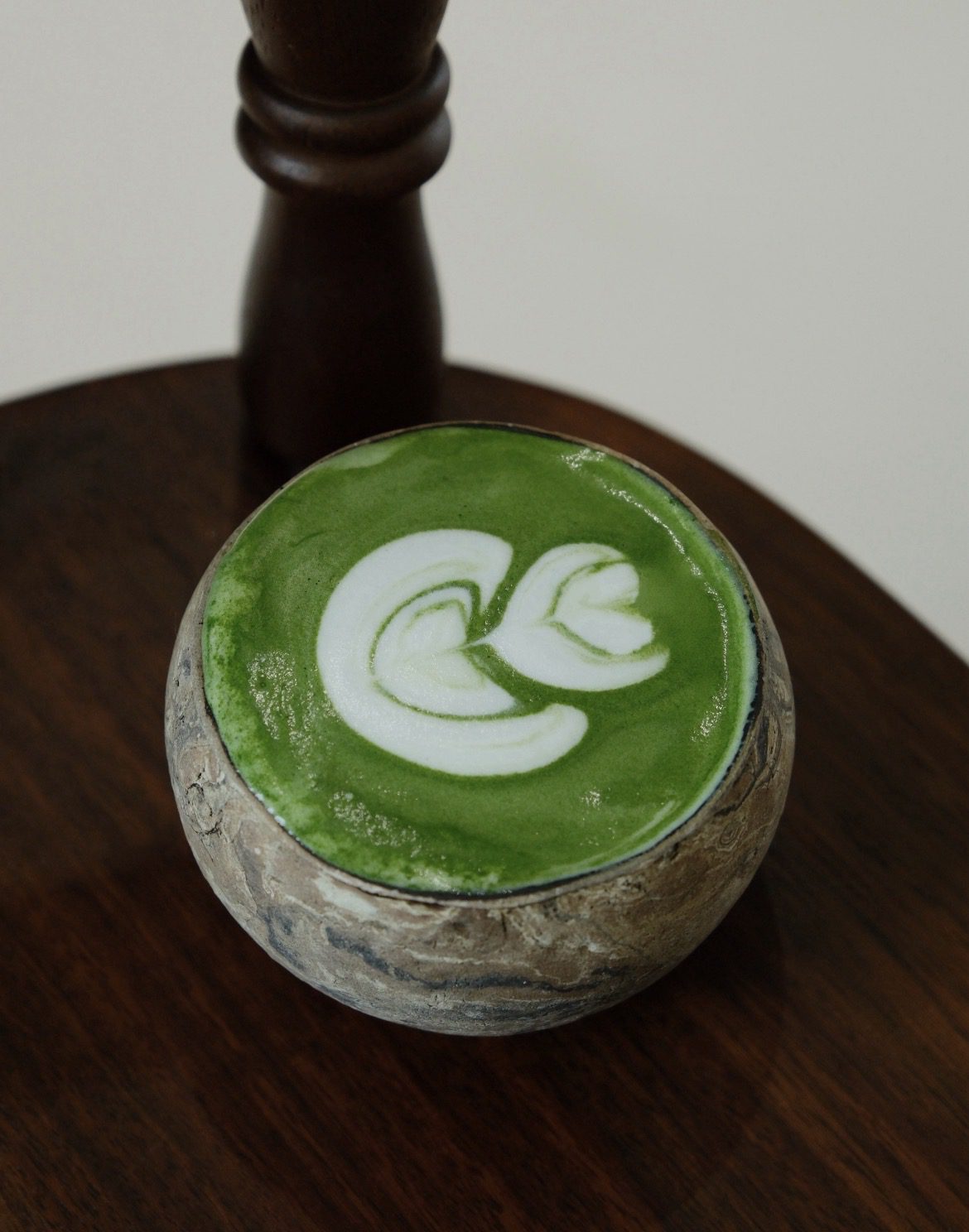
Why Does Matcha Behave Differently in Milk Than in Water?
A matcha latte is a formulation problem because matcha is consumed as a whole-leaf suspension, not a brewed infusion. The drinker ingests close to 100% of the leaf’s water-soluble and insoluble compounds, yet only about 30–40% of the powder actually dissolves — the rest stays as suspended particle. Any defect from garden or mill is therefore magnified in the cup, which is why precision upstream matters more for matcha than for any steeped tea.
Milk is not a passive carrier. Its caseins, whey, lipids and sugars actively rewrite matcha’s tannins and volatile aromatics, so the same powder can taste balanced in water and muddy in a latte. Building a café-grade latte therefore depends on three levers RongQing Tea engineers into each product: tannin–protein binding, catechin extraction kinetics, and the structural integrity of the microfoam. Executed poorly a latte reads astringent or separates; pushed too far the other way, an over-delicate powder is swallowed whole by the milk fat.
How Does Shade Cultivation Set a Latte Matcha’s Sweetness and Colour?
Shade cultivation is the agronomic step that gives a latte matcha its sweetness and its emerald colour. For roughly 20–30 days before the spring pluck, RongQing Tea’s bushes are held under canopies that block direct sunlight. The controlled light stress forces the plant to up-regulate chlorophyll — the luminous green that signals quality — and, more importantly for flavour, suppresses the conversion of amino acids into catechins. Deprived of light, the leaf retains an exceptionally high concentration of unconverted L-theanine, the dominant free amino acid drawn up from the roots.
L-theanine is the compound behind matcha’s umami and its naturally sweet, smooth character, and in a latte that baseline sweetness interacts favourably with milk sugars. The mechanism is a function of method, not origin: a peer-reviewed 2022 transcriptome study on a Chinese tea cultivar under 85–95% shade recorded the same shift — theanine up, epigallocatechin down. RongQing Tea applies this shade-cultivation standard on Chinese terroir precisely to build the high-amino-acid base a milk drink needs.
What Makes Matcha Astringent, and Why Does Milk Tame It?
Astringency in matcha is a tactile drying sensation, not a taste, and milk is what neutralises it. When unbuffered matcha is consumed, its catechins — chiefly epigallocatechin-3-gallate (EGCG) — and broader tannins bind to proline-rich proteins in saliva and precipitate them, producing the puckering roughness on the tongue. Introduce milk and its proteins, β-casein in particular, bind those catechins first; peer-reviewed sensory studies confirm this measurably reduces astringency. By pre-sequestering the tannins in the cup, milk stops them reaching the drinker’s saliva — the exact mechanism by which milk masks the harshness of lower-grade or over-extracted matcha.
That masking also explains a common surprise with high-umami matcha: a marine or “fishy” note. This is not spoilage but an over-concentration of L-theanine and glutamic acid colliding with imperfect preparation. Because heavily shaded matcha sits on a sensory knife-edge, the wrong water temperature or an incompatible plant milk tips the savoury notes into a seaweed register. The correction RongQing Tea recommends is to lower the initial extraction nearer 70 °C than 80 °C and cold-whisk the paste before milk arrives.
Which Matcha Grade Should a Café Buy for Lattes?
The premium barista, or latte, grade is the correct default for café-level lattes — not the most expensive ceremonial tier. The industry sorts matcha into ceremonial, premium and culinary, but these labels are unregulated, so a café must buy against behaviour under milk rather than a sticker. Ceremonial grade, from the first spring harvest and stone-milled to roughly 5–10 microns, is defined by delicacy and near-zero bitterness; poured under heavy dairy or thick oat it is easily overwhelmed, leaving an expensive cup that tastes of grassy milk.
Culinary grade sits at the other extreme: plucked in the second or third flush, its older leaves convert more L-theanine into catechins, yielding a coarser, sharply bitter powder that can read metallic or chalky in a refined latte. The premium barista grade is the engineered bridge — it keeps the emerald colour and fine solubility of ceremonial leaf but carries a firmer catechin backbone, so when milk arrives that measured astringency lets the tea pierce the dairy lipids and casein without collapsing into harshness.
Which RongQing Matcha Fits Which Latte Build?
RongQing Tea selects latte matcha by cultivar and single-origin terroir rather than a generic grade label, under a Garden-to-Application model that controls the chain from garden management through tencha production, milling and application support. Two complementary Chinese terroirs anchor the range: the West Lake / Hangzhou zone (Zhongcha 108 and Longjing 43 cultivars) and the high-amino Xiangxi / Wuling Mountains zone in Hunan (Baojing Golden Tea). Three products span the latte spectrum.
West Lake Barista
Balanced, jade-green and fresh-brisk with a clean orchid-and-chestnut lift. Both cultivars are recognised as matcha-suitable — high in chlorophyll and amino acids, moderate in polyphenols — with Zhongcha 108 carrying a higher amino-acid load than its Longjing 43 parent. Enough backbone to read clearly through milk without turning grassy.
Iced & Oat
Brisk, direct and vegetal with a firm structural backbone, blended from a higher-catechin fraction so the green-tea signal survives thick oat or heavily sweetened builds. The professional café workhorse.
Wuling Gold
Soft, sweet and silky, driven by an exceptionally high free-amino-acid content — early-spring leaf of this cultivar has been measured at up to 7.47% amino acids, roughly twice a typical green-tea cultivar of the same period, with a correspondingly low phenol-to-amino ratio. A recognised Chinese Geographical Indication.
Selection logic. For a smooth hot latte, reach for West Lake Barista first. For iced drinks, oat-milk builds or anything sweetened, Iced & Oat holds its ground. Wuling Gold is the tea-forward pour. Dosing follows the same logic: with the high-catechin Iced & Oat blend a standard 2.0–3.0 g dose is enough because the structure is already assertive, while the softer Wuling Gold may scale toward 4.0 g so milk fats do not erase its nuance. Exact SKU designations, tasting scores and lab figures (D50 / D90 particle size, amino-acid %, polyphenol %) are confirmed on each product’s certificate of analysis.
How Do Milk Choices Change the Cup?
The milk is an active solvent that decides how much of the tea’s identity survives, and the choice is a formulation variable a buyer should specify per drink. Milk polysaccharides and proteins can mask off-notes so effectively that a weak matcha becomes almost tasteless — so the milk must be matched to the grade, not chosen by default.
Whole dairy
High animal fat plus complete casein froths into a rich, stable microfoam and lifts perceived sweetness. The same richness turns cloying if the lipids form a cap that fails to integrate.
Oat (barista)
The global café standard: carbohydrate sweetness complements matcha’s umami, and fortified barista blends build dense foam. Low in protein, so its failure mode past 60–65 °C is starch gelatinisation — a porridgey, scorched-grain character — not protein denaturation. Steam gently to 55–60 °C.
Soy (barista)
High protein makes resilient foam that holds latte art. Flavour is divisive — neutral sweetness for some, a beany clash for others. Unsweetened barista soy is the strongest high-protein plant option.
Almond
Generally the weakest performer: too little protein for stable microfoam, prone to splitting against heat and acidic tannins, with a nutty note that often fights the tea. Light but structurally thin.
How Should Sweeteners Support Matcha Without Burying It?
Premium and ceremonial matcha carry their own sweet, umami finish and rarely need sugar, so a sweetener should synergise with the tea rather than flatten it under sucrose. For lower-grade or more astringent powders, a small amount of a mineral-rich sweetener is the most reliable lever for improving the cup. RongQing Tea recommends three modulator families for café menus.
Mineral-rich unrefined sugars — unrefined black-sugar syrups carrying potassium, iron and trace minerals — add a deep, malty, molasses complexity that bridges matcha’s vegetal bitterness and the milk’s creaminess more cohesively than refined syrup; the trade-off is a darker colour, so a clear syrup dosed with a trace mineral salt preserves a clean green latte. Honey rounds out aromatics but must be whisked into the hot matcha paste before cold milk; maple dissolves hot or cold and suits iced oat builds; stevia avoids the glycemic load but needs a careful hand. For added dimension, a teaspoon of kinako (roasted soybean flour) whisked into the dry powder introduces Maillard-derived pyrazines — toasted, nutty aromatics that anchor matcha’s high grassy frequencies and thicken the body.
What Preparation Method Gives a Repeatable Latte?
Three variables carry most of the outcome for a repeatable latte: de-agglomeration, hydration temperature and emulsion-building. RongQing Tea specifies each so a multi-site menu pours consistently.
First, always sift. Milled under 10 microns, matcha bonds into hard clumps under static and moisture; passing it through a fine stainless sieve prevents grit and pockets of concentrated bitter powder. Second, control temperature — the single most decisive lever for astringency. Boiling water scorches shade-grown leaf and over-extracts bitter catechins, so whisked matcha belongs in a 70–80 °C window; for a latte, a more robust grade can be hydrated toward 80–85 °C to pull the extra catechin structure needed to read through dairy. Third, build a concentrated “matcha shot”: combine about 2–3 g of sifted powder with 30–60 ml of roughly 80 °C water into a paste, and agitate a pre-softened bamboo whisk in a rapid zig-zag “W” or “M” motion — never circular — so the tines shear agglomerations and entrain a glossy microfoam. Whisk any sweetener into this hot concentrate. For hot lattes, steam milk to a maximum of about 65 °C and pour over the shot; for iced, pour cold milk over ice first, then the hot shot slowly on top for the signature layered look.
What Are the Dosing Ratios for Hot and Iced Lattes?
Repeatability across a café menu depends on weighing the powder gravimetrically and measuring liquids volumetrically. The table below gives RongQing Tea’s reference ratios; dose up for iced drinks to offset ice-melt dilution and cold-muted perception, and down for high-catechin blends whose structure is already assertive.
| Application | Matcha | ~80 °C water | Milk | Notes |
|---|---|---|---|---|
| Standard hot latte | 2.0 g | 60 ml | 240 ml | Classic 1:30:120 ratio — balanced, creamy, for daily drinking |
| Strong café latte | 3.0 g | 30 ml | 80 ml | A flat-white analogue; maximises matcha intensity over volume |
| Standard iced latte | 2.5–3.0 g | 60 ml | 240–300 ml | Extra powder offsets ice-melt dilution |
| Intense iced latte | 3.5–4.0 g | 40 ml | 130 ml | Deep green hue and aggressive umami that pierces thick oat or almond |
How Do Terroir and Storage Protect Latte Consistency at Scale?
Terroir sets the chemical baseline a latte can reach, and storage decides how much of it survives to the cup — both matter more for a multi-site programme than any single barista’s technique. RongQing Tea draws on two distinct Chinese origins: the West Lake / Hangzhou heartland in Zhejiang, whose subtropical mist at 300–500 m and quartz-rich sandy loam give a chestnut-sweet, floral character; and the Xiangxi / Wuling Mountains around Baojing county in Hunan, whose near-constant cloud is a natural analogue to artificial shading over acidic (pH 4.5–5.5) sandstone-shale soils rich in phosphorus, iron, magnesium and selenium. That vertical, Garden-to-Application chain is the traceability guarantee behind every batch — the practical answer to the transparency question that separates credible matcha from commodity powder in EU and US markets.
Storage protects that baseline. Matcha’s enormous surface area makes it acutely sensitive to oxidation, light and heat: exposed, its chlorophyll degrades to pheophytin and the powder dulls to olive while amino acids oxidise into flat, fishy notes. Keep it in a fully opaque, airtight tin; refrigerate once the factory seal is broken; let the tin return to room temperature before opening to prevent condensation; and, for the intended profile, consume within two to three months of opening.
Matcha for Lattes: Frequently Asked Questions
What matcha grade is best for café lattes?
Premium barista, or latte, grade is best for café lattes — not the most expensive ceremonial tier. Ceremonial grade, stone-milled to roughly 5–10 microns from first-flush leaf, is built for whisking with water and is easily overwhelmed by milk, leaving a costly cup that tastes of grassy milk. Culinary grade, from later-flush leaf with more catechins, can read metallic or chalky in a refined drink. Premium barista grade bridges the two: it keeps the emerald colour and fine solubility of ceremonial leaf but carries a firmer catechin backbone, so it pierces dairy lipids and casein without turning harsh. RongQing Tea’s West Lake Barista is the recommended default for hot milk builds.
What water temperature should a matcha latte be made at?
Whisked matcha belongs in a 70–80 °C window, and a latte can run slightly higher, toward 80–85 °C for a robust grade. Boiling water at 100 °C scorches shade-grown leaf, over-extracting bitter catechins while volatilising the delicate L-theanine that carries sweetness. For a latte the extra few degrees pull the additional catechin structure a tea needs to read through milk. The milk itself is a separate limit: steam dairy to a maximum of about 65 °C, and oat milk more gently to 55–60 °C, because past that point oat starch gelatinises into a porridgey character. Hydrate the matcha shot first, then integrate the gently steamed milk.
Why does an oat-milk matcha latte sometimes taste porridgey or scorched?
An oat-milk matcha latte tastes porridgey because oat milk is low in protein, so overheating it triggers starch gelatinisation rather than the protein denaturation seen in dairy. Past roughly 60–65 °C the oat starches produce a gelatinous, scorched-grain character, the natural sweetness drops, and foam quality suffers. Barista oat blends fortified with oils, emulsifiers and stabilisers extend the window slightly, but the reliable fix is to steam oat milk gently to 55–60 °C. This is a frequent point of confusion because baristas assume the failure mirrors dairy, where β-lactoglobulin denatures near 70 °C; for oat the limiting reaction is in the carbohydrate, not the protein.
How much matcha powder goes into a hot versus an iced latte?
A standard hot latte uses about 2.0 g of matcha to 60 ml of ~80 °C water and 240 ml of milk — the classic 1:30:120 ratio — while a stronger café build uses 3.0 g in 30 ml water with 80 ml milk for a flat-white intensity. Iced lattes need more powder, typically 2.5–3.0 g and up to 3.5–4.0 g for an intense cup, because ice-melt dilutes the drink and cold mutes perception. Grade also shifts the dose: a high-catechin blend such as RongQing Tea’s Iced & Oat performs at 2.0–3.0 g because its structure is already assertive, whereas a soft ceremonial grade may scale toward 4.0 g so milk fats do not erase the tea.
How should bulk matcha be stored to keep café lattes consistent?
Bulk matcha should be stored cold, dark, airtight and dry, because its very large surface area makes it acutely sensitive to oxidation, light and heat — the main causes of batch-to-batch drift across a multi-site menu. Exposed to air and light, chlorophyll degrades to pheophytin and the powder dulls from emerald to olive, while amino acids oxidise into flat, bitter, fishy notes that milk cannot fully hide. Keep unopened stock in fully opaque, airtight packaging; refrigerate once a seal is broken; and let a container return to room temperature before opening to prevent condensation. For the intended profile, work through opened stock within two to three months. RongQing Tea ships bulk lots in nitrogen-flushed barrier packaging for a longer sealed shelf life.
Source a latte-matched matcha, or formulate a house blend to spec.
Request Samples & COAGrounded in single-origin Chinese cultivars and traditional tencha process standards, backed by RongQing Tea’s Garden-to-Application traceability. Educational content; product specifications should be confirmed against the current certificate of analysis before commercial or client-facing use.